How to use a visual schedule at home (step by step)
A visual schedule is a row of pictures that shows a child what happens now and what comes next. This guide shows how to set one up at home, teach your child to use it and keep it working, with our free printable cards.
How to use it, step by step
- Pick one hard moment. Start with one routine that often goes wrong, such as getting ready in the morning or bedtime. You can grow the schedule later.
- List the steps. Write down the steps in the order your child really does them, for example toilet, wash, pyjamas, brush teeth, story, sleep. Put an enjoyable step after a harder one.
- Print and prepare the cards. Print our free visual schedule cards and cut them out. If you can, laminate them and add Velcro or magnets. Photos of your child work well too.
- Hang it at eye level. Put the strip where the routine happens, at your child's eye level, for example in the bathroom or on the fridge.
- Show and say. Before the routine, look at the pictures together. Point and use few words: “First teeth, then story.”
- Mark what is done. After each step, your child turns the card over or puts it in a “done” pocket. Seeing the steps disappear shows progress.
- Praise and stay consistent. Praise the effort straight away: “You brushed your teeth!” Use the same cards in the same order every day.
- Add steps and fade help slowly. When the routine runs smoothly, add another part of the day. Give less help over time, for example point to the schedule instead of saying every step.
Common mistakes to avoid
- Too many pictures at once: start with 3 or 4.
- Using the schedule only when things go wrong: use it every day, on good days too.
- Changing the order without warning: if the plan changes, change the card together and say why.
Tip for grown-ups
Expect a learning period. Following a schedule is a skill: it can take one or two weeks of daily use before your child uses it on their own.
📚 Which research is this based on?
Visual supports, including visual schedules, are listed as an evidence-based practice in the NCAEP 2020 report. The AFIRM Visual Supports module and the family handouts of the National Center for Pyramid Model Innovations (NCPMI) describe the same steps: choose a routine, show the steps in pictures, teach the child to use them and mark what is done. The UK NICE guideline CG170 also mentions visual supports.
- NCAEP 2020 report: Steinbrenner, J. R., Hume, K., Odom, S. L., et al. (2020). Evidence-Based Practices for Children, Youth, and Young Adults with Autism. FPG Child Development Institute, University of North Carolina at Chapel Hill, National Clearinghouse on Autism Evidence and Practice (NCAEP).
- AFIRM: Visual Supports: AFIRM (Autism Focused Intervention Resources and Modules), FPG Child Development Institute, UNC: Visual Supports module.
- NCPMI: Visual Schedules at Home: Jiron, A., Brogle, B., & Giacomini, J. (2013, updated 2018). How to Use Visual Schedules to Help Your Child Understand Expectations. Backpack Connection Series, National Center for Pyramid Model Innovations (NCPMI).
- NCPMI: Visual Supports for Routines: National Center for Pyramid Model Innovations (2020). Visual Supports for Routines, Schedules, and Transitions (home version).
- NICE CG170: NICE (2013, updated 2021). Autism spectrum disorder in under 19s: support and management (CG170). National Institute for Health and Care Excellence, UK.
Frequently asked questions
At what age can a child use a visual schedule?
Many children can use a simple picture schedule from about 2 or 3 years. Start with photos or very clear pictures and only 2 or 3 steps.
How many pictures should a visual schedule have?
Start with 3 or 4 pictures for one routine. Add more when your child follows them easily. Some children later use a whole-day schedule.
What if my child refuses the schedule or pulls off the cards?
Stay calm and keep it short. Make the first step something your child enjoys, let them help choose and place the cards, and praise every use of the schedule. If it stays hard, ask your child's teacher or therapist for ideas.
Also try
- Printable PDFVisual schedule
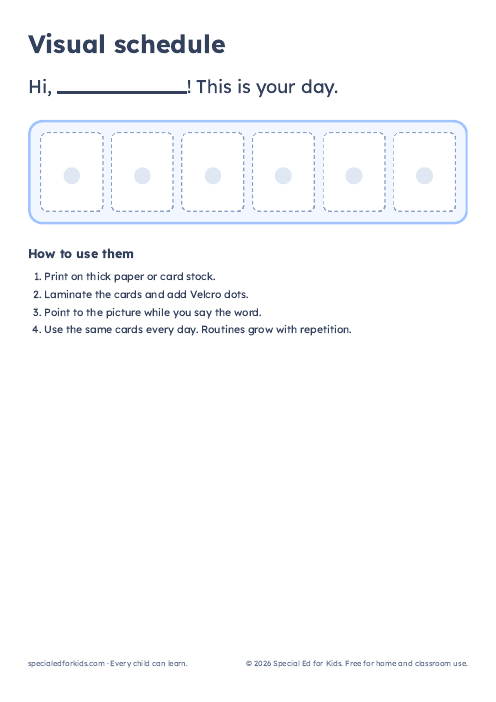
Picture cards for the daily routine, from waking up to bedtime, plus blank cards to draw your own.
- Printable PDFFirst-then board
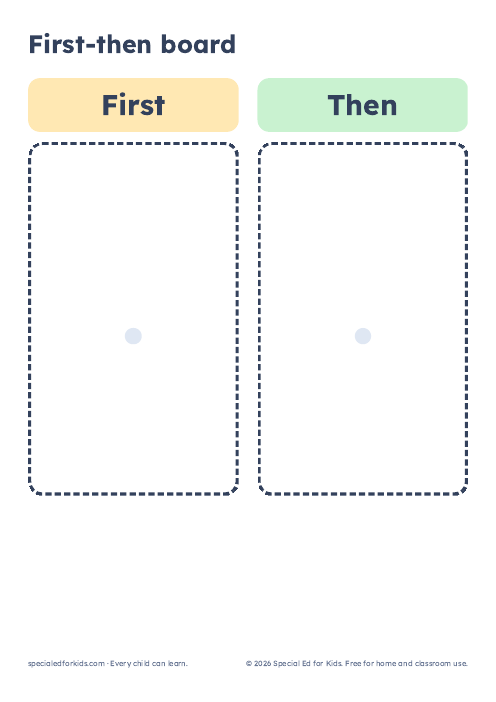
Two boxes: first the task, then something the child enjoys.
- Printable PDFToken board
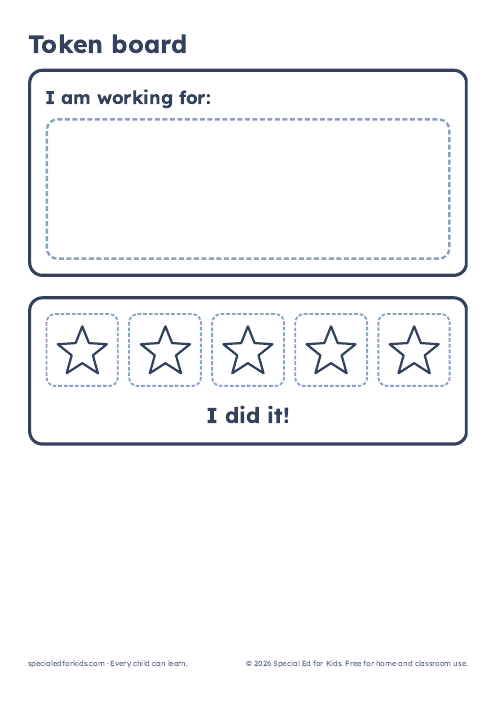
The child earns five stars, then gets the reward they chose.
- Printable PDFEmotions cards
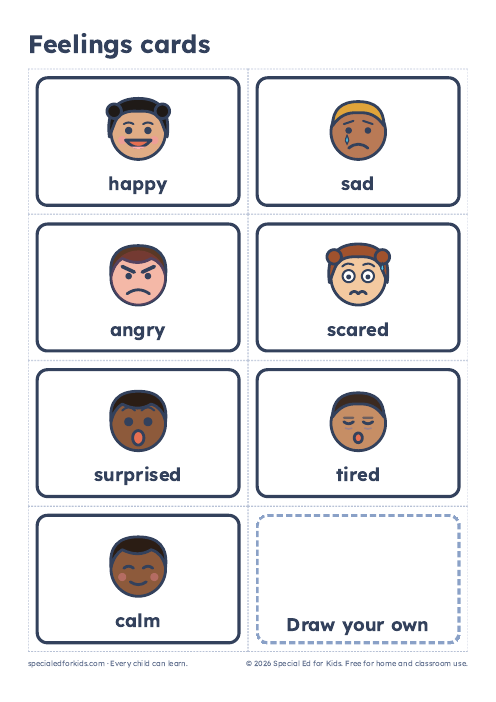
Seven feelings faces plus a daily “How do I feel today?” check-in chart.
- Printable PDFSocial story template
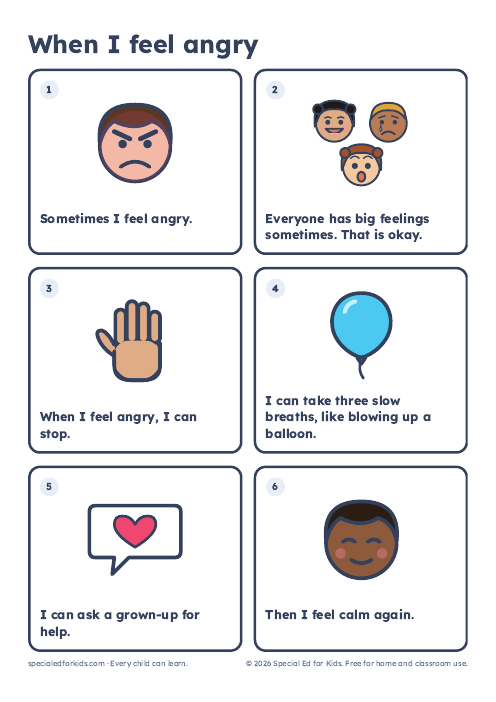
A blank 6-box story template and an example story: “When I feel angry”.
- Browser gameFeelings faces
Who feels happy, sad or angry? Learn feeling words with friendly faces.
- Browser gameListen and find
Hear a word and find the picture: food, animals and everyday things.
- Browser gamePicture match
Find the same picture. One clear task at a time, no timer and no losing.
- Browser gameCounting 1–10
Tap each picture to count, then find the right number.
- Browser gameSorting game
Drag each picture to the right box: colors, shapes, then animals, food and vehicles.
- Browser gameDaily routine in order
Put morning, day and evening pictures in order, with gentle hints.
- Browser gameMemory pairs
Turn two cards and find the pairs. Starts with only four cards.