Listen and find: vocabulary game for kids
The game says a word, for example “Find the cat”. Tap the right picture. Level 1 has two pictures, level 3 has four. Turn the sound on: this game is made for listening.
Listen and find
Tip for grown-ups
Use the same words in daily life. Words that children hear often in real moments are learned best.
How to use it, step by step
- Turn the sound on and sit with the child. Say the word again in your own voice.
- If the child is unsure, wait a few seconds before you point. The game shows a hint after a wrong tap.
- After playing, find the real things at home: “Where is your cup?”
📚 Which research is this based on?
One clear instruction, one response and calm feedback is the structure of discrete trial teaching (AFIRM). Waiting a few seconds before helping is called time delay, and the hint after a wrong tap follows the AFIRM Prompting module. Oral vocabulary is a foundation for reading (IES What Works Clearinghouse). This is a learning game, not a therapy programme.
- AFIRM: Discrete Trial Training: AFIRM, FPG Child Development Institute, UNC: Discrete Trial Training module.
- AFIRM: Time Delay: AFIRM, FPG Child Development Institute, UNC: Time Delay module.
- AFIRM: Prompting: AFIRM, FPG Child Development Institute, UNC: Prompting module.
- IES/WWC: Foundational Reading Skills (K–3): Foorman, B., et al. (2016). Foundational Skills to Support Reading for Understanding in Kindergarten Through 3rd Grade (NCEE 2016-4008). Institute of Education Sciences, What Works Clearinghouse.
Also try
- Printable PDFEmotions cards
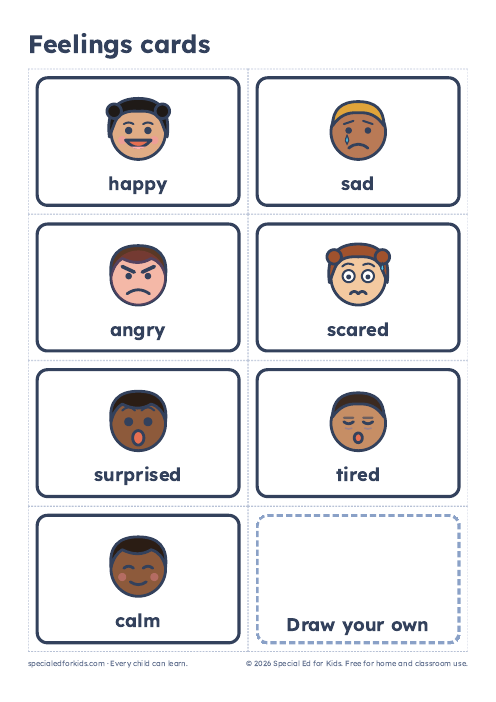
Seven feelings faces plus a daily “How do I feel today?” check-in chart.
- Browser gameFeelings faces
Who feels happy, sad or angry? Learn feeling words with friendly faces.
- Browser gamePicture match
Find the same picture. One clear task at a time, no timer and no losing.
- Browser gameCounting 1–10
Tap each picture to count, then find the right number.
- Browser gameSorting game
Drag each picture to the right box: colors, shapes, then animals, food and vehicles.
- Browser gameDaily routine in order
Put morning, day and evening pictures in order, with gentle hints.
- Browser gameMemory pairs
Turn two cards and find the pairs. Starts with only four cards.
- Printable PDFVisual schedule
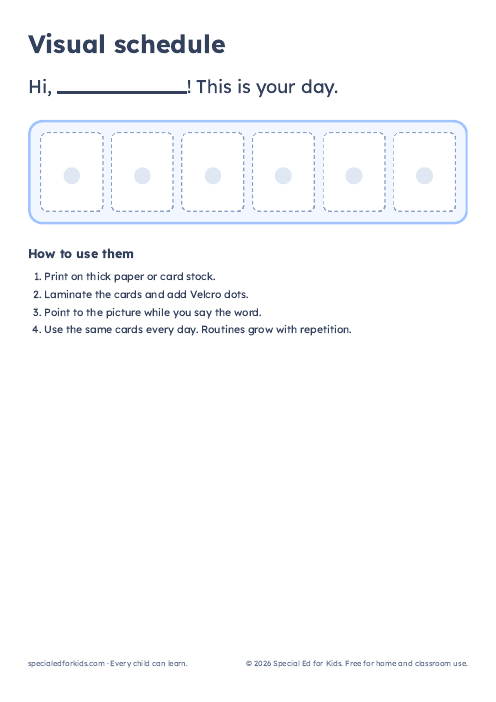
Picture cards for the daily routine, from waking up to bedtime, plus blank cards to draw your own.
- Printable PDFFirst-then board
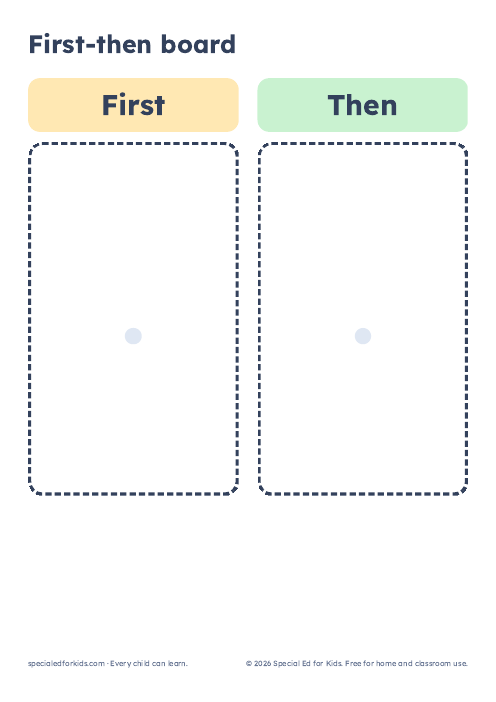
Two boxes: first the task, then something the child enjoys.
- Printable PDFToken board
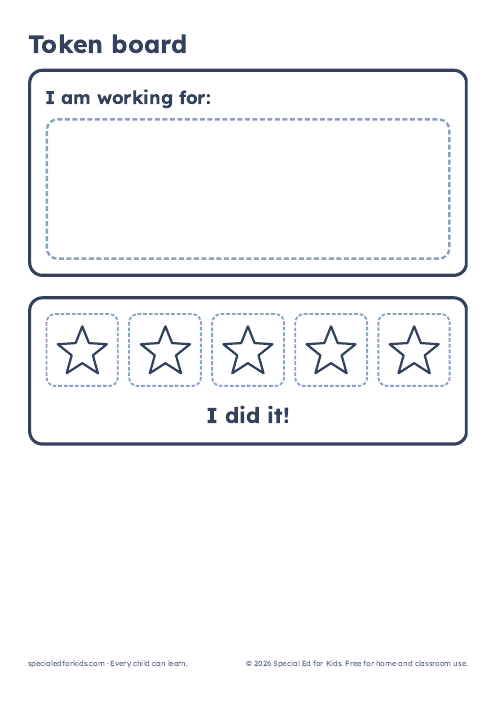
The child earns five stars, then gets the reward they chose.
- Printable PDFSocial story template
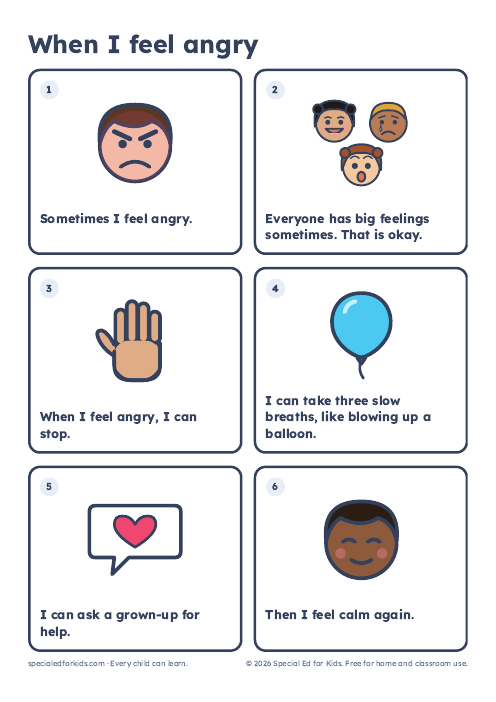
A blank 6-box story template and an example story: “When I feel angry”.
- Guide for parentsHow to use a visual schedule at home
A step-by-step guide for parents: set up, teach and slowly fade a picture schedule.