Free printable emotions cards for kids
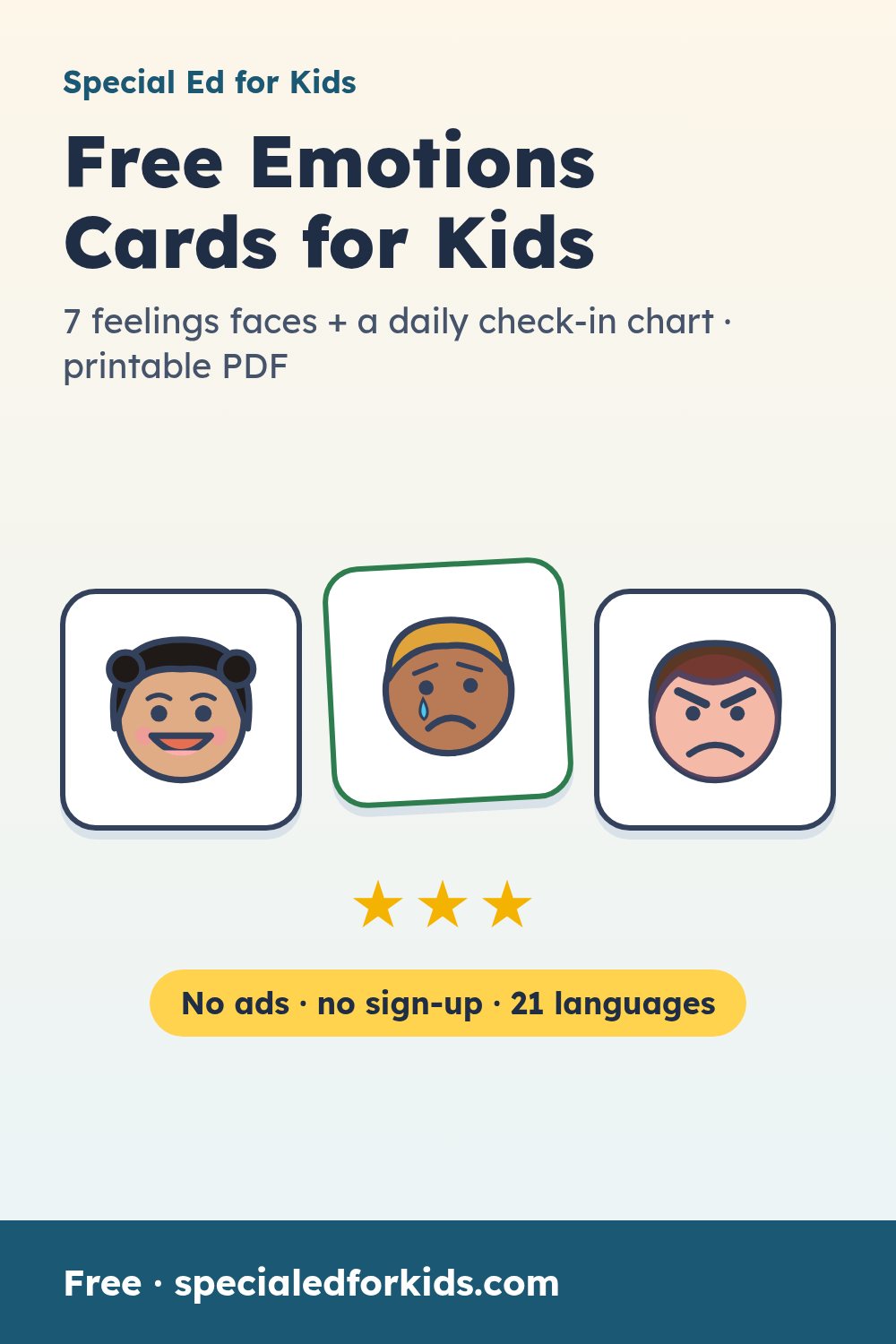
Seven clear feelings faces with large words, a blank card to draw your own, and a “How do I feel today?” check-in chart. Naming a feeling is a first step toward talking about it and asking for help.
Download (free PDF, A4, prints on US Letter)
How to use it, step by step
- Print on thick paper. Cut out the cards and keep the check-in chart whole.
- Start with two or three feelings, such as happy, sad and angry. Add more once the child knows them.
- Name feelings in everyday moments: “You are smiling. You look happy.” Point to the matching card.
- Use the cards in play: make the face in a mirror, find the feeling in a picture book or play a matching game.
- Once a day, use the check-in chart. The child points to a face or puts a clip on it. Accept every answer.
- Practise when the child is calm. During a big feeling, keep words short and offer comfort first.
Tip for grown-ups
Name your own feelings too: “I feel tired. I will sit down for a minute.” Children learn feeling words by hearing them used.
📚 Which research is this based on?
Teaching children to recognise and name emotions is part of social skills training, which the NCAEP 2020 report lists as an evidence-based practice, and part of the Pyramid Model for young children's social-emotional development (NCPMI). Picture cards are a visual support. The research is about these practices, not about this specific printable.
- NCAEP 2020 report: Steinbrenner, J. R., Hume, K., Odom, S. L., et al. (2020). Evidence-Based Practices for Children, Youth, and Young Adults with Autism. FPG Child Development Institute, University of North Carolina at Chapel Hill, National Clearinghouse on Autism Evidence and Practice (NCAEP).
- AFIRM: Social Skills Training: AFIRM, FPG Child Development Institute, UNC: Social Skills Training module.
- NCPMI: Understand and Label Emotions: Brogle, B., Jiron, A., & Giacomini, J. How to Help Your Child Understand and Label Emotions. Backpack Connection Series, National Center for Pyramid Model Innovations (NCPMI), funded by OSEP, U.S. Department of Education.
- AFIRM: Visual Supports: AFIRM (Autism Focused Intervention Resources and Modules), FPG Child Development Institute, UNC: Visual Supports module.
Frequently asked questions
At what age can children learn feeling words?
Many children start to name simple feelings such as happy and sad at around 2 to 3 years. These cards are made for ages 3 to 7: begin with two feelings and add more slowly.
How do I use a feelings check-in chart?
Choose a fixed moment, for example after breakfast or at the start of class. The child points to the face that matches how they feel. Thank them and accept the answer: there is no wrong feeling.
Are emotions cards only for autistic children?
No. Feelings cards can help any young child, including children with ADHD, language delays or Down syndrome. Adapt the number of cards and the words to the child.
Also try
- Browser gameFeelings faces
Who feels happy, sad or angry? Learn feeling words with friendly faces.
- Printable PDFVisual schedule
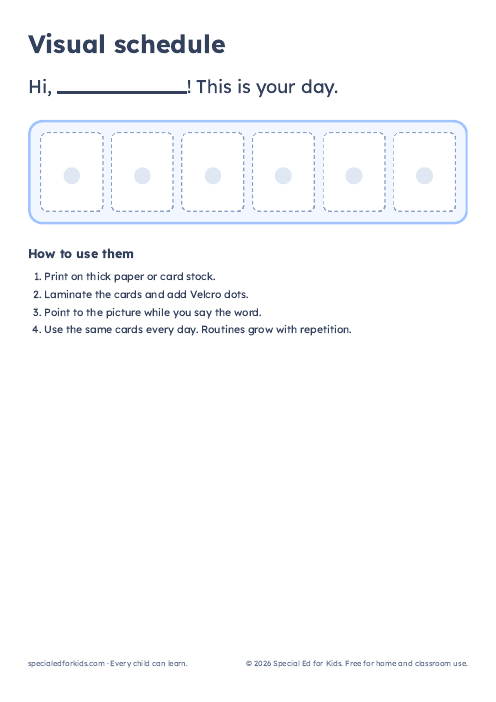
Picture cards for the daily routine, from waking up to bedtime, plus blank cards to draw your own.
- Printable PDFFirst-then board
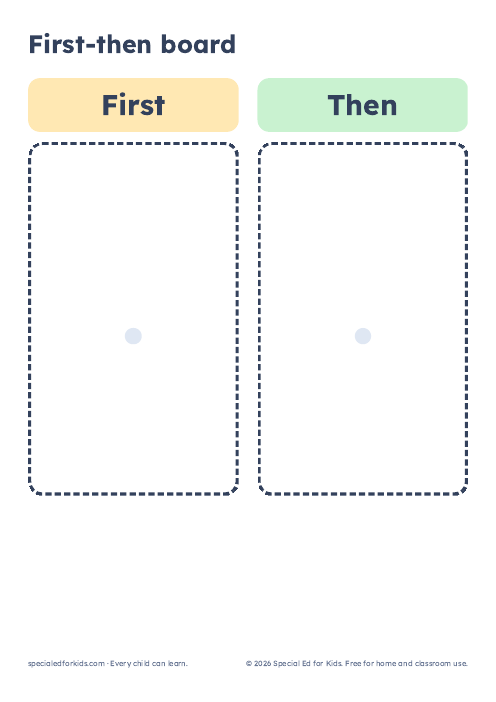
Two boxes: first the task, then something the child enjoys.
- Printable PDFToken board
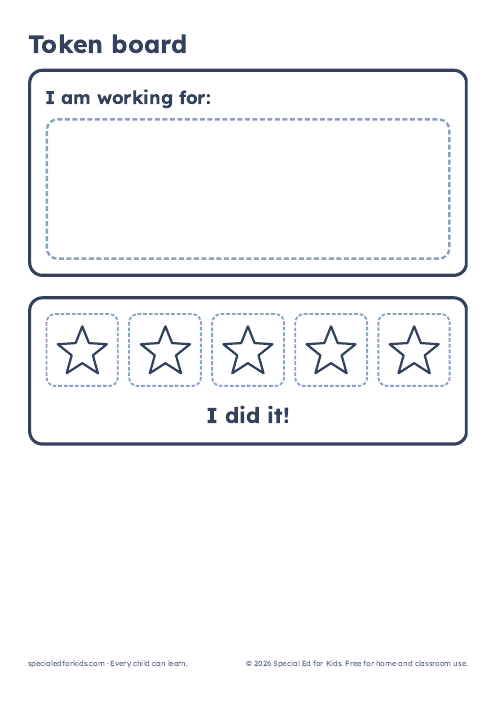
The child earns five stars, then gets the reward they chose.
- Printable PDFSocial story template
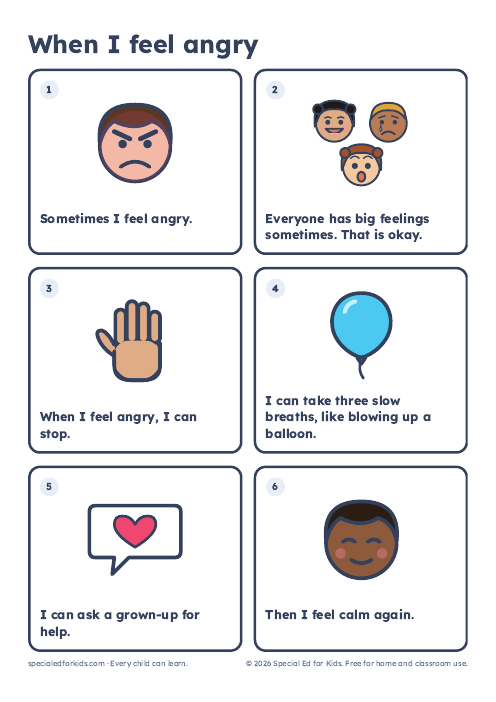
A blank 6-box story template and an example story: “When I feel angry”.
- Guide for parentsHow to use a visual schedule at home
A step-by-step guide for parents: set up, teach and slowly fade a picture schedule.
- Browser gameListen and find
Hear a word and find the picture: food, animals and everyday things.
- Browser gamePicture match
Find the same picture. One clear task at a time, no timer and no losing.
- Browser gameCounting 1–10
Tap each picture to count, then find the right number.
- Browser gameSorting game
Drag each picture to the right box: colors, shapes, then animals, food and vehicles.
- Browser gameDaily routine in order
Put morning, day and evening pictures in order, with gentle hints.
- Browser gameMemory pairs
Turn two cards and find the pairs. Starts with only four cards.